

Software Update
Sharper, Faster Insights and Smarter QI.
Sharp Reflections Release 2026.3
Sharp Reflections Software 2026.3 is now available for download.
Building on the innovation delivered in Release 2026.2, Sharp Reflections 2026.3 introduces an integrated set of capabilities for higher-fidelity seismic characterization, quantitative interpretation, and scalable subsurface analysis.
Sharp Reflections 2026.3 advances four core technical domains:
AASPI integration brings four major algorithms—DIPS3D, Similarity3D, Curvature3D, and SOF3D—developed by the University of Oklahoma and implemented with a major international oil company.
Live Trace Only (LTO) analysis now enables two- and three-term AVO evaluation directly on irregular datasets before regularization, allowing you to analyze your data in its native geometry.
New interactive AVO/AVA workflows provide dynamic attribute extraction and linked Intercept-Gradient (I-G) analysis for faster calibration and screening.
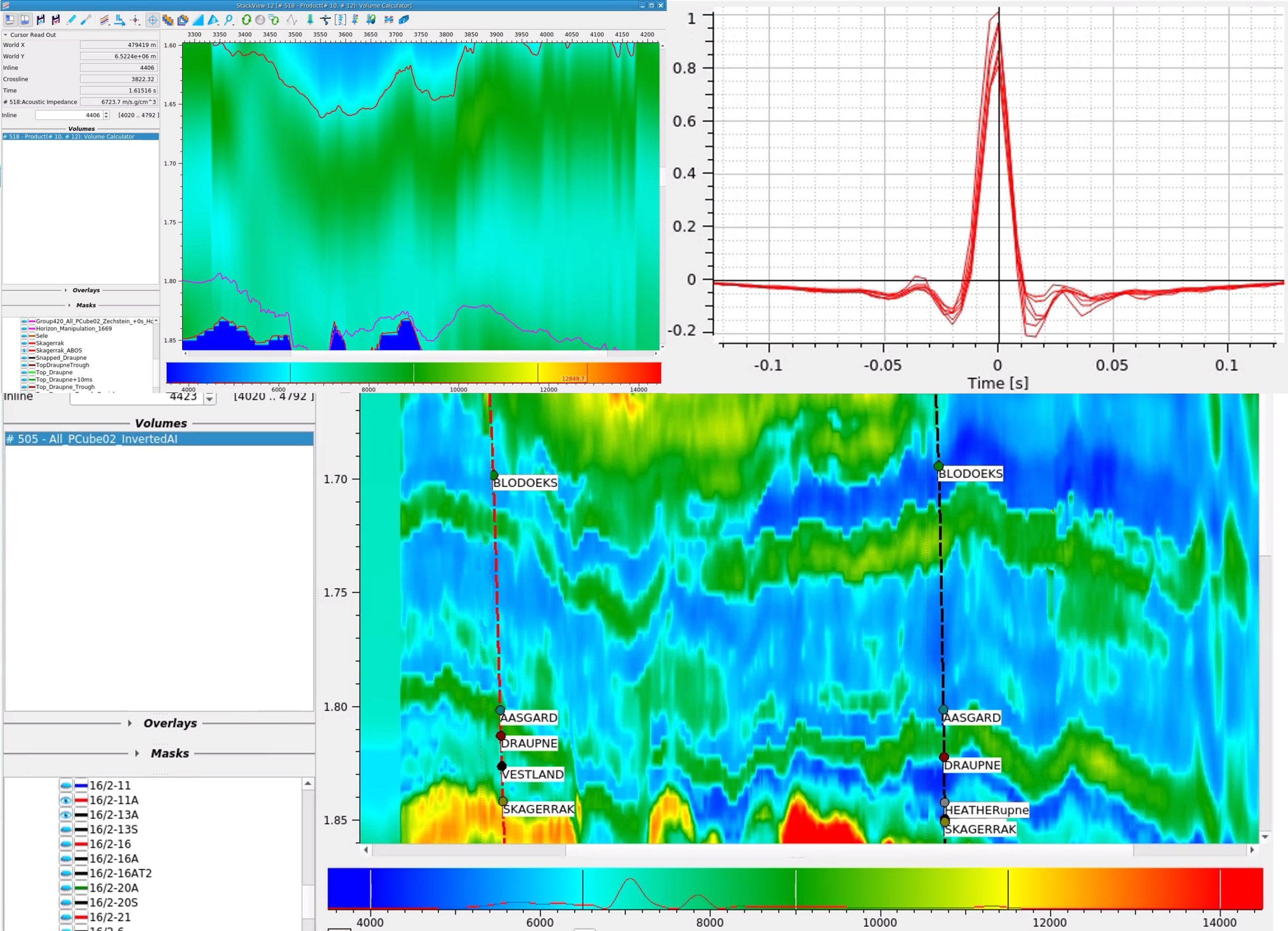
Elastic Inversion enhancements reduce memory requirements and strengthen background-model construction. The concept of an active wavelet has also been added to Sharp Reflections to significantly improve inversion setup.
What’s New in 2026.3
Four technical advances. One integrated interpretation platform.
Sharp Reflections 2026.3 adds survey-scale AASPI geometric attributes, native-geometry Live Trace Only analysis, dynamic Interactive AVO, and a streamlined Elastic Inversion workflow. Generate and QC structural attributes at scale, evaluate AVO before regularization, link seismic responses directly to well calibration, and build deterministic inversion models with lower memory demand and tighter quality control.
Major Features and Improvements:
AASPI
The AASPI developments bring four key geometric attribute tools into Sharp Reflections: DIPS3D, Similarity3D, Curvature3D and SOF3D, supporting seismic analysis and interpretation at large scale. Together, they enable interpreters to characterize structural dip, identify reflector discontinuities, analyze curvature, and apply structure-oriented filtering while preserving faults and reflector edges. Integrating these capabilities into a combined attribute-generation and denoising workflow supports faster quality control and geological interpretation on large datasets. These new capabilities help interpreters investigate structural and stratigraphic architecture, test geological hypotheses, and assess the effects of seismic conditioning within a combined workflow.
DIPS3D establishes the structural framework.
A semblance-search algorithm calculates volumetric dip, azimuth and confidence attributes from stack seismic, providing inputs for similarity, curvature and structure-oriented filtering.
Similarity3D highlights reflector discontinuities.
Dip-aligned analysis measures seismic continuity to help identify faults, channels, fracture systems and other structural or stratigraphic boundaries. The energy-ratio method uses eigen-structure-based coherence to compare coherent energy with total energy within the analysis window.
SOF3D conditions seismic along structure.
The algorithm ranks overlapping analysis windows by local coherence and applies smoothing within the most coherent window to preserve reflector edges and faults. Available options include principal-component filtering, an alpha-trimmed mean, a LUM (Lower-Middle-Upper) filter and a conventional mean.
Curvature3D characterizes reflector geometry.
Maximum and minimum principal curvature attributes describe local structural shape, while low-pass and band-pass filtering help emphasise longer-wavelength geological features and suppress unwanted high-frequency noise.
The integrated workflow combines advanced attribute generation, structure-oriented denoising and rejected-noise QC to preserve geological fidelity. In one benchmark, Sharp Reflections processed DIPS3D, Similarity3D, SOF3D, Curvature, maps and QC across a 3,000 km² survey in 10’ minutes, compared with several hours using the current implementation.
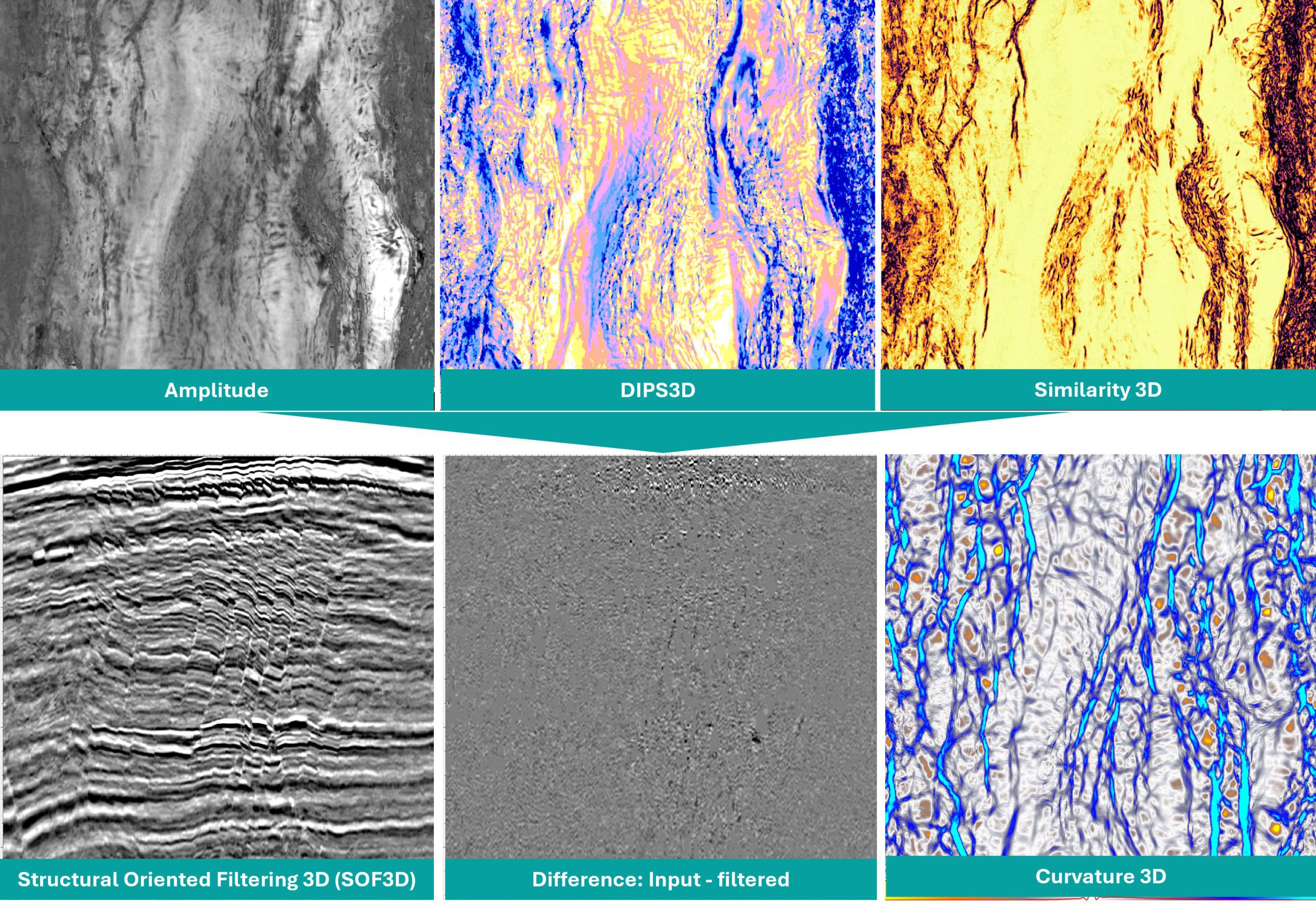
Sharp Reflections enables rapid, iterative testing of AASPI attribute parameters within a flexible, integrated workflow engineered for survey-scale deployment.
Title
Live Trace Only (LTO)
Live Trace Only (LTO) developments extend amplitude analysis to irregular seismic datasets. This is particularly relevant to Ocean Bottom Node seismic data, where the LTO handling is a way to evaluate complex acquisition geometries earlier in the analysis process.
Following the recent development of Live Trace Only with the 2026.1 and 2026.2 releases, Sharp Reflections now extends the deployment of Shuey two- and three-term AVO analysis to irregular LTO datasets, allowing users to calculate intercept and gradient attributes on native seismic acquired traces. Users can therefore begin AVO evaluation on the LTO representation and bring quantitative amplitude information into their workflow earlier. This enables earlier analysis of datasets with complex acquisition geometries, including Ocean Bottom Node surveys, without requiring an initial regularization step. This is completing the existing workflow supporting stencil operations such as time alignment and spectral analysis, while additional denoising, RMO and Radon demultiple capabilities remain planned for months to come. Stay tuned!
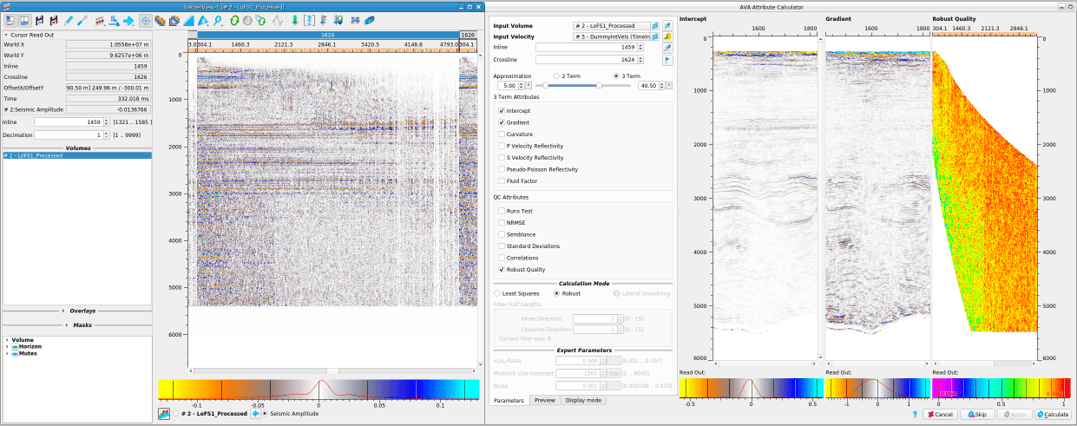
Snail sorted gathers (left) with their corresponding Intercept-Gradient analysis (right).
Interactive AVO CDP analysis
Interactive AVO CDP analysis connects attribute extraction from seismic angle gathers with dynamic intercept-gradient crossplots, supporting closer integration between seismic observations and well-derived AVA responses. The development, undertaken in collaboration with a major International Oil Company, focuses on interactive calibration and AVO screening across three-dimensional and multidimensional datasets
Interactive AVO developments connect seismic attribute extraction directly to dynamic intercept-gradient crossplots, enabling users to explore AVO behavior interactively across their seismic dataset. Enhancements include extraction between or around horizons, linked updates between extraction and crossplot views, and dynamic labelling of intercept-gradient values. This workflow combines seismic and well-derived AVA measurements to support calibration and earlier evaluation of leads and prospects.
Linked extraction and cross-plotting allow interpreters to examine amplitude behavior in its seismic context rather than relying solely on isolated attribute displays. Well integration adds a further calibration reference for evaluating those observations. The intended benefit is a more dynamic interactive screening process in which users can explore seismic AVA responses and compare them with well information within the same analysis workflow.

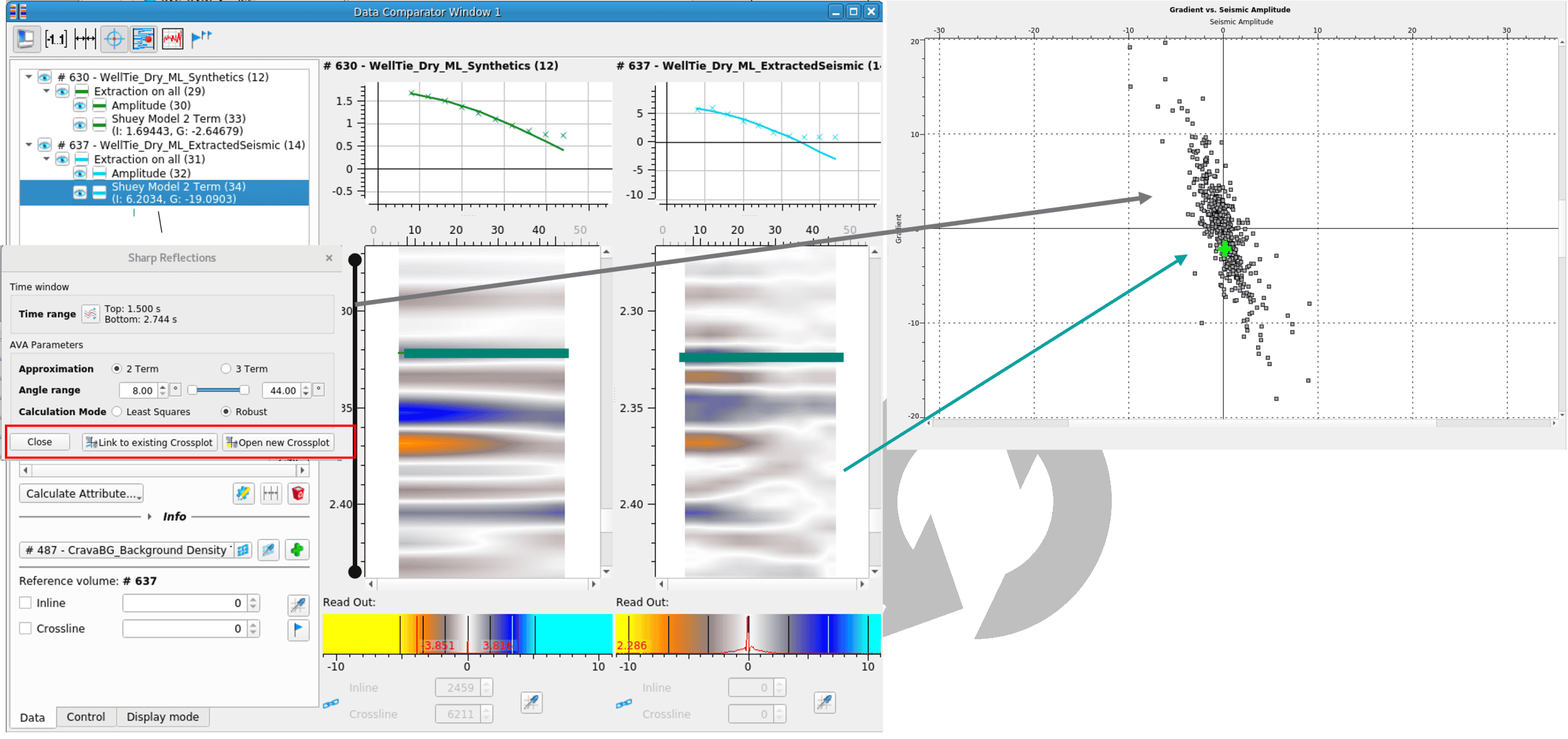
An intercept-gradient cross-plot from a seismic dataset (grey points) between an interval of interest (time and/or horizons bounded) and well synthetic gather response at a particular time event (green dot). The time interval and/or time sample can be adjusted live in the seismic/synthetic panel, and the corresponding updated points will be updated into the intercept-gradient cross-plot.
Elastic Inversion
Elastic Inversion developments address the preparation and usability of deterministic inversion workflows, with particular emphasis on background model construction and memory requirements. There is now also consistency in terminology and logic between CRAVA elastic inversion and PCube+ probabilistic inversion. The work also strengthens wavelet handling and seismic-to-well quality control within the inversion workflow
Elastic Inversion developments improve the deterministic inversion workflow through lower memory requirements and a more consistent interface aligned with our Bayesian Probabilistic Inversion (PCube+) terminology and logic. Background model enhancements simplify naming and ordering, improve trend extrapolation across zones and remove the requirement for a one-to-one interpretation grid. Active-wavelet handling, synthetic seismograms using the active inversion wavelet and seismic QC log overlays strengthen calibration and quality control, with further inversion development still ongoing.
These changes target the practical work required to prepare and evaluate an inversion. Elastic Inversion remains an ongoing development project, with additional wavelet functionalities and inversion completion identified separately on the roadmap, stay tuned!

Availability
Sharp Reflections Software 2026.3 is now available.
Get started today. For assistance or more information, contact our support team at customersupport@sharpreflections.com.
Stay Sharp,
Cyrille Reiser, Product and Engineering Team,
Sharp Reflections

Connect with us to start your journey to unlock your seismic datasets
Tell us a bit about yourself, and we’ll get back to you.